Written in May: I Want to Be Someone Who Creates
This article was originally written in Chinese. Also available in 日本語.
Issue #1 · BGM: Wu Bai – Last Dance
I’ve long since lost count of how many films and games I’ve gotten through. For years now, I’ve handed most of my time over to other people’s creations. Countless films watched late at night and forgotten by morning; countless games beaten, then left to sit quietly in my library.
Starting this month, I want to leave a record here every month: what I felt this month, which films I watched, which games I finished. Half of it is a record for myself, and half is to prove that I really did feel something from these works.
Time is limited. Before this song ends, let’s begin.
Cosmic Princess Kaguya!
The world of Tsukuyomi is modeled on VRChat. Most players who go there are longing to build some kind of connection inside it, to escape the emptiness of the real world. Across 500 hours of playtime, I did find a few stand-ins — but more often, what I found was a deeper loneliness once everything had scattered.
The protagonist’s initial state is a lot like people in the modern city. When she meets Kaguya, she treats her as a burden in her life, wants to drive her away and get back to that exquisite but dull existence. But she’s gradually changed by Kaguya, until she can no longer leave her. And she, in turn, changes Kaguya — leaving behind, in the end, a longing that spans a thousand years. The two need each other, and both become better versions of themselves.
I think this might be one way out of the emptiness of an atomized society: to admit that you need love, to pursue richness of the spirit, to create.
Limbus Company
I still remember the afternoon I cried my eyes out after clearing the Spider’s Nest. Once I’d calmed down and thought it over, this is really just a successful ensemble script for a gacha game. But only Project Moon could, with a worldview built across three works (and Mili), pull off a story like this.
What I’d rather talk about is a certain stream by the producer, Kim Ji-hoon. It’s worth knowing the backstory here: he was tormented by his mother in childhood to the point of bipolar disorder, and at the same time founded Project Moon, one of the pillars of Korean gaming. Recommended reading: “Only in games can we ‘forgive.’ In this cruel world.”
In the stream he talked about a lot, holding nothing back. At first I assumed this was the usual sob-story marketing move gacha companies pull, but it wasn’t — Project Moon is just a ragtag little circle, with none of that PR savvy. I’m fully convinced that what he said in the stream is the real situation he’s facing, and that makes these works all the more precious. Although the city in the game is one where people devour people, what it tells, from start to finish, is a story with a deeply loving core. The Spider’s Nest — how much of it drawn from his own childhood, I don’t know — resonates all the more deeply with readers who grew up in East Asian families. Even though this is a free-to-play game, its authorial voice is not diminished in the slightest.
SUPERHOT VR
If Limbus Company is a work of hope its author made after living through darkness, SUPERHOT carries the pure malice of its Polish author. Under the immersion that VR grants by nature, the game opens by asking the player to pick up a gun with the controller, aim it at their own head, and pull the trigger. In VR this moment is magnified without limit: the player has to stare, with their own eyes, down the pitch-black muzzle, while raising their own right hand in real life. Nothing like it had ever existed in any game — no wonder in ‘21 the dev team conceded that “you deserve better” and removed this scene entirely.
But as gameplay it’s flawless. “Time moves only when you move” — this core concept inherited from the original fuses naturally with VR; the VR version also adopts a fully stationary, standing-in-place style of play, and redesigns its mechanics around it. With time paused, it even gives the player plenty of buffer time, which fundamentally rules out any possibility of VR sickness.
Claude
Even though I’m quite put off by anthropomorphizing AI, using Claude gives me the illusion of working alongside a brilliant elite — it actively presses for details, and it’ll even veto some of my requests.
But at the end of the day it’s still just an AI. I once turned to Claude for two problems: one, why my headset still wouldn’t debug properly after connecting to the PC; two, why I couldn’t export my game correctly in Unity. It did everything it could to analyze them for me, investigating the tiniest details, digging up some forum reply from n years ago, explaining concepts to me I’d never heard of and would never hear of again. But the actual solutions were simple and absurd: 1. My headset wasn’t plugged into the body unit at the front, but into the battery at the back. 2. In Unity you have to fill in a name before you can export the file. These two utterly common-sense problems — ones I could’ve solved just by calming down and taking one more look — instead had me spinning in circles with the AI for half an hour, and when I finally realized it, all I could do was give a wry smile.
Finally, let me talk about Vibe Coding. I don’t think students should use AI for programming less — on the contrary, it’s the fastest way to turn an idea in your head into something playable.
There are two reasons. First, AI-generated code still needs you to debug it; some very subtle differences are often what determine a game’s “feel” — and this part still demands heavy human involvement. Second, game programming itself requires creativity; “how do I realize a certain feature in my head” is itself a kind of design ability. Writing code with AI lets me put more energy into “is this gameplay actually fun,” instead of having to burn huge amounts of energy implementing it first.
Other Works
Dispatch: Beaten in 8 hours. Early on it leans on stock, archetypal characters to crank out laughs fast, keeping the player feeling fresh throughout. Aside from a stiff twist at the ending, it’s a superhero work whose flaws don’t outweigh its strengths.
Sultan’s Game: The first time I played the DEMO, I couldn’t believe this was a domestic (Chinese) game. But in fact, only Chinese could deliver this kind of expressive power. So far I’ve only cleared the Revolution route; I’ll slowly finish the rest later.
Resident Evil 4 Remake: A masterpiece. I eagerly await the brain-computer-interface remake 18 years from now.
Seihantai na Kimi to Boku: Very sweet — only, the lead resembles my middle school friend so much that it pulls me out of it a little.
The Boys: A work that keeps up its heavy, freakish shock value right to the very end — it can cram a three-minute scene of cat-and-dog mutants sniffing each other’s butts into the second-to-last episode, which should have been tightly paced. On script alone, the show is a complete failure, yet it succeeded in pulling off a Meta satire of the internet. But this layer of satire wasn’t in the crew’s plan at all; they use “we’re being satirical” to paper over a whole pile of the work’s own problems. And at that point, the whole thing turns into an even bigger irony.
The Best Thing This Month
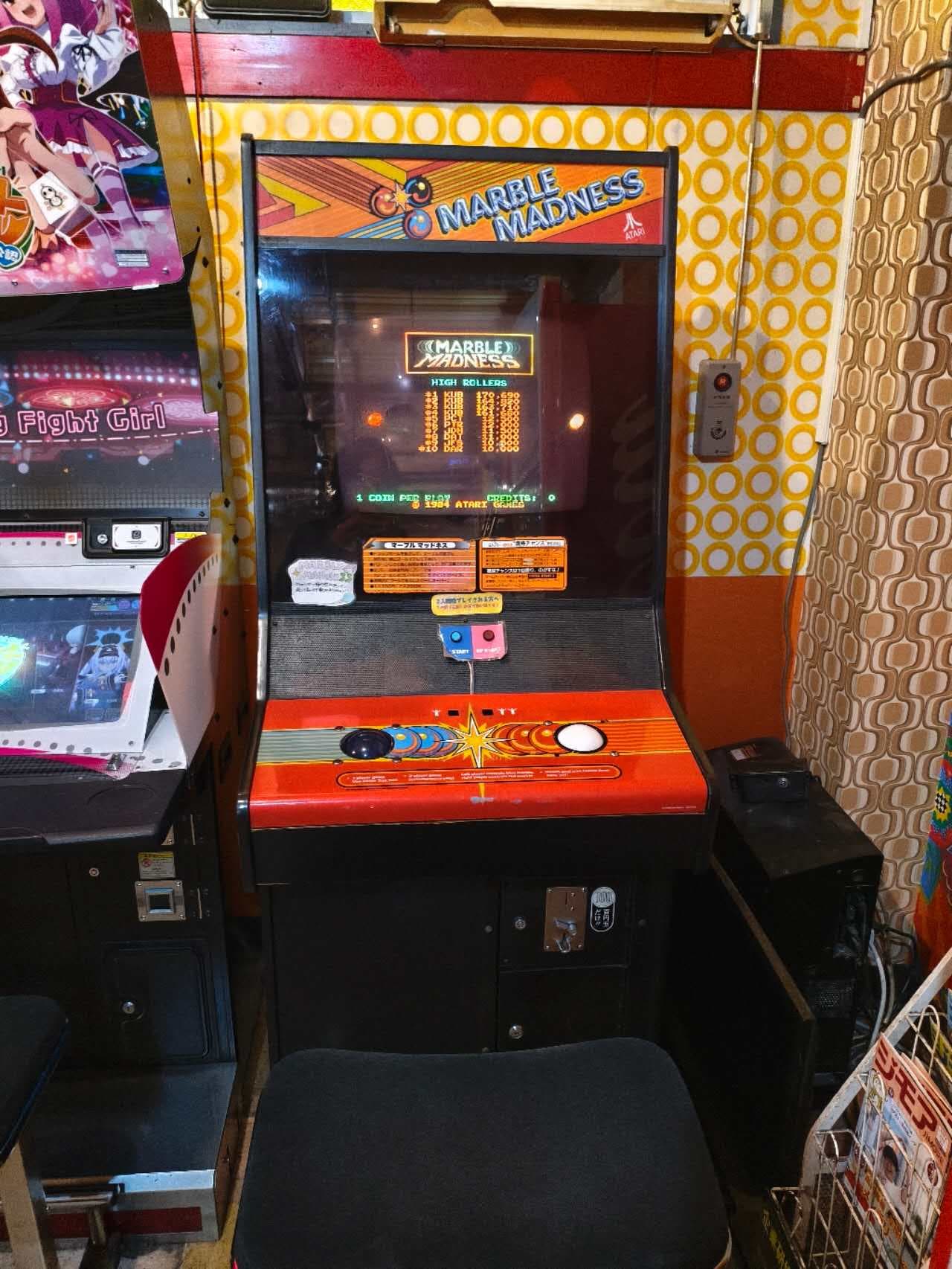
I visited Mikado, an arcade in Takadanobaba, Japan, where it felt like time had never moved at all — you could feel the very earliest days of video games there. I even saw a PONG reproduction cabinet by Atari.